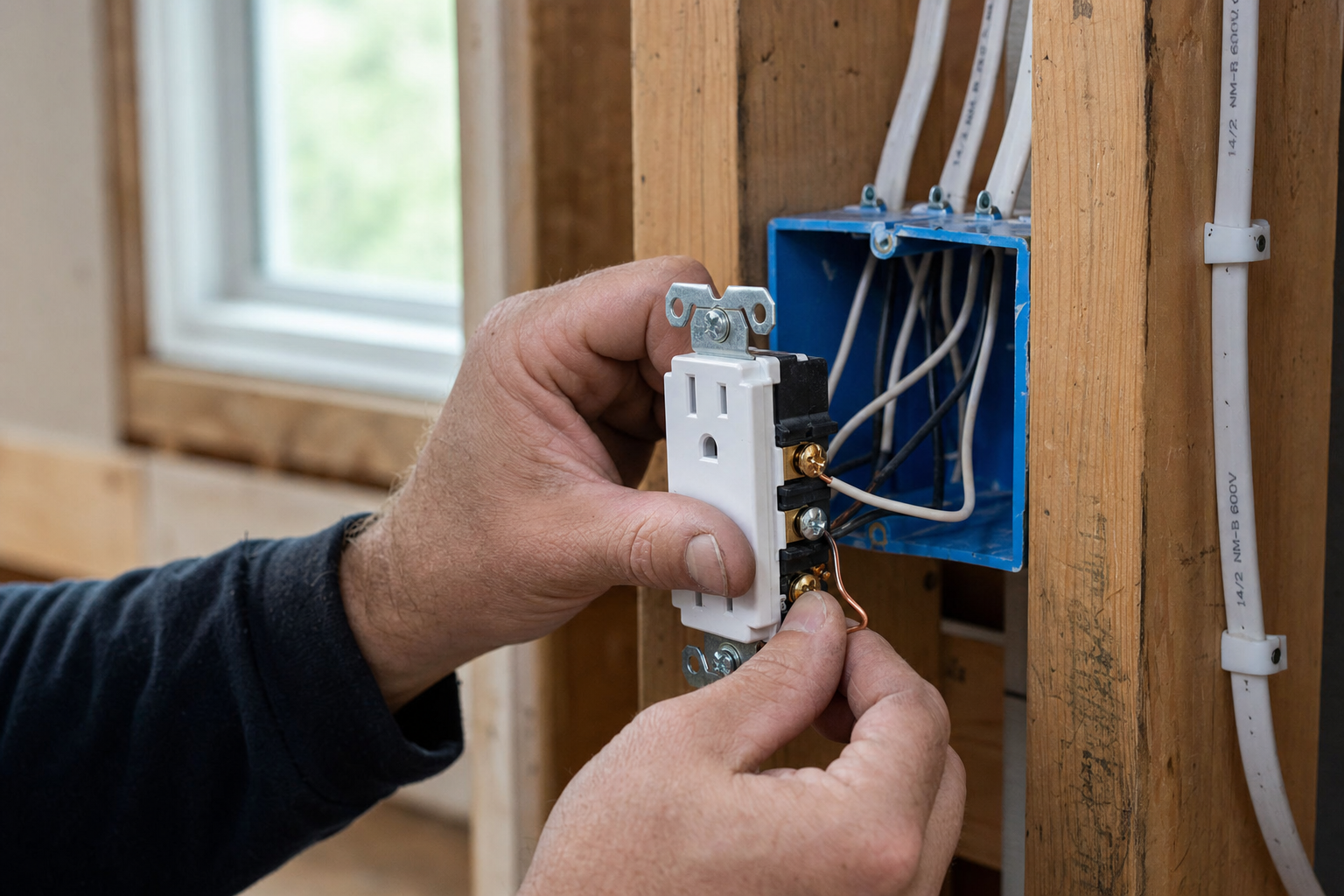
Common troubleshooting calls
- A breaker that trips every time you turn on a specific appliance.
- Outlets that stopped working, sometimes after another contractor finished a job.
- Lights that flicker, dim, or burn out faster than they should.
- A buzzing panel or a warm breaker (this one: call right away).
- An insurance or home inspection that flagged something and you need it documented and corrected.
- Bad work from a previous owner or a previous electrician that you want fixed properly.
Wiring services
- New dedicated circuits (workshop, hot tub, mini-split, sauna, kiln, hot water tank).
- Knob-and-tube removal and full rewires, often done in phases so you stay in the house.
- Aluminum wiring remediation with COPALUM or AlumiConn connectors.
- Surge protection at the panel.
- GFCI / AFCI retrofit on circuits that need it.
- Sub-panels for additions, garages, and detached structures.
Whole-house rewires
- Older homes with knob-and-tube, cloth-jacketed wiring, or aluminum branch circuits can usually be brought up to current code without gutting the house.
- John walks the whole house, maps what's existing, and quotes the work in phases (kitchen circuit first, bedrooms next, etc.) so you can budget over a year or two if you'd like.
- Every rewire ends with a labeled panel, a clear circuit map, and inspection sign-off.
How a job goes
Honest diagnostic
John traces the problem at a flat hourly diagnostic rate. You're not paying to watch someone shotgun replacements until the lights work.
Findings & quote
Once the problem is identified, you get a written quote for the actual fix before the work starts. You can say yes, no, or sleep on it.
Repair
Done clean, to current code, and with the panel labeled when it's back up.
Documentation
If this was an insurance or inspection issue, you get the paperwork you need to close it out.
FAQ
My house was wired in the 1950s. Is it dangerous?
Not automatically. It depends on what's been added since, how the splices were done, and what kind of insulation the original wire has. Cloth-jacketed two-wire is common in 1950s New Hampshire homes and is usually safe if it hasn't been damaged. Knob-and-tube is a different conversation. John walks the house, looks at the splices, and tells you what's worth doing.
Can you fix what another electrician did?
Yes, all the time. John doesn't talk smack about other contractors. He just looks at what's there, tells you what needs to change, and fixes it.
Do I have to be home for troubleshooting?
Helpful but not required. If you can describe what happens, when it happens, and what's on at the time, John can usually trace it without you there. A lockbox or hidden key works for the appointment.
What about aluminum wiring?
Aluminum branch wiring (common in homes wired between 1965 and 1973) is fine if the terminations are correct. John uses COPALUM or AlumiConn pigtails at every device. That's the methodology insurance companies and Underwriters Laboratories actually accept. Just smearing antioxidant paste on existing terminations is not a real fix.